Brownface – AAPAC and The Roundabout Theatre Company

I received an email this morning with the letter below and find it appropriate to discuss / post here.

I do not agree with Blackface and certainly do not agree with”Brownface” to depict Asian Americans. It seems that with the diverse acting pool in the city, The Roundabout would have found a way to use it.

As a playwright, I can respect the way a play is written and understand staying true to the script, however, we are no longer in the 19th century — people of color have more than a great deal of rights (we are all equal), so why do the play at all??

It could be a matter of personal taste and most likely a matter of subscribers…. this is the type of play they will attend, this is the type of play that puts The Roundabout as much in the black as possible.

I am a theatre artist, a producer, a woman of color…. I might understand why this play was chosen, but I don’t have to like it.

If I get the chance to attend a performance, I will surely report back.

For now, read below and be your own judge.

____

AAPAC Opposes Brownface in Roundabout Broadway Production

After seeing The Roundabout Theatre Company’s Broadway production of “The Mystery of Edwin Drood” and receiving numerous complaints about the use of brownface in the production, AAPAC feels it is necessary to release the following public statement:

We were deeply disappointed to see white actors impersonating characters of South Asian descent complete with brown grease paint, appropriation of costumes and dance movements and relying on stereotypes in place of characterization. The obvious talents of the actors notwithstanding, the use of brownface had the effect of being extremely surreal and alienating, as if a joke was being told that was not intended for the Asian American community to hear.

We understand that the racism inherent in this musical is a reflection of the social mores within 19th century British panto and Music Hall traditions. Director Scott Ellis was being true to tradition, historical precedent, and to the story itself.

However, we would assert that if these characters came from the British colonies of Jamaica or Cameroon, and not the British colony of Ceylon (now present day Sri Lanka), blackface would never have been utilized in the same casual way. Today, you would never see a white actor in blackface playing the title role in “Othello” with the excuse of, “oh, well, that’s what was done in Shakespeare’s day.” We wonder why minstrelsy is acceptable when it comes to Asians?

The Roundabout production seems to show little awareness of the long history of Asian impersonation we are trying to put behind us or how racial politics and demographics have changed even in the 28 years since this show first premiered. There were a myriad of ways Mr. Ellis could have handled this issue with more sensitivity. For one, he could have hired actors of actual South Asian descent. Or, if he wanted to preserve white actors in these roles, the use of brownface would have been more ironic or satirical had the entire ensemble been cast multi-culturally. This would have been particularly effective since Hispanic-American star Chita Rivera was already in the cast. However, we have heard from quite a few members of the Asian acting community, including those with major Broadway credits, that requests from their representatives to secure an audition were denied.

The Roundabout Theatre Company does not have a good record when it comes to inclusive casting. Last year, we released a report looking at the percentages of actors of color hired at 16 of the top not-for-profit theatre companies in New York City over a five year span. The Roundabout made our list of the five theatre companies least likely to hire actors of color. In fact, they ranked second to lowest.

We are reaching out to the Roundabout to engage in closed-door discussions about these issues and are hopeful that they will accept our invitation. We are certain that their record does not reflect a conscious policy of exclusion and we hope that by bringing these issues to a more conscious level, the Roundabout can become an ally in an industry-wide commitment to more inclusive casting.

In the meantime, if you feel as strongly as we do, it would be very helpful if you take two minutes to send Artistic Director Todd Haimes a short missive via their FB page:

https://www.facebook.com/RoundaboutTheatreCompany.

Until there is conscious attention given to these issues throughout the industry, opportunities for American actors of Asian descent–and all actors of color– will never be truly equal.

Yours in Solidarity,

The AAPAC Steering Committee

Pun Bandhu, Cindy Cheung, Kimiye Corwin, Angel Desai, Siho Ellsmore, Christine Toy Johnson, Peter Kim, Julienne Hanzelka Kim, Nancy Kim Parsons, Kenneth Lee, Allan Mangaser, Eileen Rivera

___

View the Letter in Original Format

AAPAC on Faceook

AAPAC = Asian American Performers Action Coalition

Competing to be June Cleaver

If you knew me way back when – you may not recognize me now.

Some days I feel like Martha Stewart: baking, taking care of our daughter, keeping up with housework…truly domestic. Other days, I wish I could call on my French au pair to go where I go so I could do the simple things in life that we all take for granted…like go to the restroom without fearing I’ll have to jump off to save my daughter who may have fallen in the other room, even though she’s just fine and asleep soundly in her crib.

I mechanically begin working on dinner around 5:30/6 so by the time my husband comes home, something is on the table. Numerous things fall by the way side and I have the most fun after midnight – writing. Sleep comes when I need it, but my candle is certainly burning at both ends…. And why?

Because I can’t just be a mother. I can’t just plan play dates and obsess over what nursery school my baby will go to in 2 -3 years. I try to do it all and end up in a race with myself. Every time I take a breather, I regret it- I try to stay one step ahead and end up feeling like I’m one step behind trying to please everyone (especially myself).

I am certainly not alone (I sure hope not) as mothers like me around the country figure out how to have “it all”. Some have more help than others, with an au pair or family member – others, like me, do it alone during the day while the other spouse works. Others have no other spouse and do it all alone.

Help or no help, the June Cleaver competition is always in our subconscious.

But June Cleaver had it easy – if all I had to do was clean the house and have dinner ready, life would be a breeze… Instead I think about a career and my own personal happiness as a human on this crazy planet – never mind my husband and our happiness in life as a couple and family (which is of course a constant on my mind).

But how did I – How do we get this way – wanting everything to be perfect – or just right… trying to juggle motherhood and wife-Dom like we’re going to get a badge at the end of this raceto add to our sash – like we’re going to move up in the rankings.

I mean … sometimes It would be better if sleep were optional…

… And who is all of this for? Maybe we want to win one of those network tv “Mother of the Year” contests, and be picked over thousands of other deserving mothers…. Is that what our mothers wanted?

Are we recreating their lives in a google age?

My 1st year into this life as wife AND mother sent me into a homemaker mode many never knew existed or thought I would enjoy (myself included). But I was no longer “playing house” as I did as a child. This was real!

At the end of the day, June Cleaver’s life seemed perfect, but that sort of perfection has a dangerous price. If you find that you are driving yourself crazy over the minutiae and need a break, take one! Afterall, June Cleaver had commercials…
——-
If you are wondering what this has to do with “being black”, it has everything to do with Identity which is what I gained when I “discovered” my blackness… A sense of self that could be carried throughout the different avenues of my life.

Competing to be June Cleaver

If you knew me way back when – you may not recognize me now.

Some days I feel like Martha Stewart: baking, taking care of our daughter, keeping up with housework…truly domestic. Other days, I wish I could call on my French au pair to go where I go so I could do the simple things in life that we all take for granted…like go to the restroom without fearing I’ll have to jump off to save my daughter who may have fallen in the other room, even though she’s just fine and asleep soundly in her crib.

I mechanically begin working on dinner around 5:30/6 so by the time my husband comes home, something is on the table. Numerous things fall by the way side and I have the most fun after midnight – writing. Sleep comes when I need it, but my candle is certainly burning at both ends…. And why?

Because I can’t just be a mother. I can’t just plan play dates and obsess over what nursery school my baby will go to in 2 -3 years. I try to do it all and end up in a race with myself. Every time I take a breather, I regret it- I try to stay one step ahead and end up feeling like I’m one step behind trying to please everyone (especially myself).

I am certainly not alone (I sure hope not) as mothers like me around the country figure out how to have “it all”. Some have more help than others, with an au pair or family member – others, like me, do it alone during the day while the other spouse works. Others have no other spouse and do it all alone.

Help or no help, the June Cleaver competition is always in our subconscious.

But June Cleaver had it easy – if all I had to do was clean the house and have dinner ready, life would be a breeze… Instead I think about a career and my own personal happiness as a human on this crazy planet – never mind my husband and our happiness in life as a couple and family (which is of course a constant on my mind).

But how did I – How do we get this way – wanting everything to be perfect – or just right… trying to juggle motherhood and wife-Dom like we’re going to get a badge at the end of this raceto add to our sash – like we’re going to move up in the rankings.

I mean … sometimes It would be better if sleep were optional…

… And who is all of this for? Maybe we want to win one of those network tv “Mother of the Year” contests, and be picked over thousands of other deserving mothers…. Is that what our mothers wanted?

Are we recreating their lives in a google age?

My 1st year into this life as wife AND mother sent me into a homemaker mode many never knew existed or thought I would enjoy (myself included). But I was no longer “playing house” as I did as a child. This was real!

At the end of the day, June Cleaver’s life seemed perfect, but that sort of perfection has a dangerous price. If you find that you are driving yourself crazy over the minutiae and need a break, take one! Afterall, June Cleaver had commercials…
——-
If you are wondering what this has to do with “being black”, it has everything to do with Identity which is what I gained when I “discovered” my blackness… A sense of self that could be carried throughout the different avenues of my life.

Post-Grad School Blues

We’ve spent hundreds of thousands of dollars on degrees that are packed in boxes we rarely unpack in between the annual apartment moves.

The time spent educating ourselves would lead one to believe that post-graduation would be a breeze.   Right….

But with an MFA in Playwrighting, Directing or Acting… job applications are not always “submit your resume and list your special skills“.  It’s not quite so black and white for everyone.

While a fair amount of our other friends are buying homes, having children or making their comfortable livings as doctors, lawyers and … there are many of us out there becoming what we’ve dreamed of since we were children, not because it will necessarily make us rich (although we’ve never complained about a couple dollars), but because it makes us happy and truly “rich”.

Upon exiting graduate school, I believe there is a cloud that follows – it’s hazy and colorful – one believes in the mirage of dreams from this cloud and then one day, you’re down, the lowest you’ve ever been and who’s there to help you?  Not help you in a little way – but help you in a way where you can be honest… we’re not talking, “did you finish the play?”.  We’re talking head-hunters and job interviews at non-profits, waiting tables, corporate resumes and working at the GAP…

Post-Grad School is full of this extra stuff that has nothing at all to do with how many beats are in this scene or what is this character’s objective.

Driving through this mess can seem hazy until you realize it’s not only you out there.  But it can all mess with your identity.  If you get caught up in “What size sweater were you looking for”, how long until you begin creating the schedule or doing things you’re good at to pay the bills.

A healthy balance is hard, but necessary.  With the right people surrounding you – totally possible.

To all my post-grad school graduates, keep driving, surround yourself with good people and don’t forget what you always wanted to be!

Post-Grad School Blues

We’ve spent hundreds of thousands of dollars on degrees that are packed in boxes we rarely unpack in between the annual apartment moves.

The time spent educating ourselves would lead one to believe that post-graduation would be a breeze.   Right….

But with an MFA in Playwrighting, Directing or Acting… job applications are not always “submit your resume and list your special skills“.  It’s not quite so black and white for everyone.

While a fair amount of our other friends are buying homes, having children or making their comfortable livings as doctors, lawyers and … there are many of us out there becoming what we’ve dreamed of since we were children, not because it will necessarily make us rich (although we’ve never complained about a couple dollars), but because it makes us happy and truly “rich”.

Upon exiting graduate school, I believe there is a cloud that follows – it’s hazy and colorful – one believes in the mirage of dreams from this cloud and then one day, you’re down, the lowest you’ve ever been and who’s there to help you?  Not help you in a little way – but help you in a way where you can be honest… we’re not talking, “did you finish the play?”.  We’re talking head-hunters and job interviews at non-profits, waiting tables, corporate resumes and working at the GAP…

Post-Grad School is full of this extra stuff that has nothing at all to do with how many beats are in this scene or what is this character’s objective.

Driving through this mess can seem hazy until you realize it’s not only you out there.  But it can all mess with your identity.  If you get caught up in “What size sweater were you looking for”, how long until you begin creating the schedule or doing things you’re good at to pay the bills.

A healthy balance is hard, but necessary.  With the right people surrounding you – totally possible.

To all my post-grad school graduates, keep driving, surround yourself with good people and don’t forget what you always wanted to be!

Happy Belated Black History Month

I was remiss in not mentioning the start of Black History Month in Friday’s “Oreo” post. One might think that with a blog entitled, “The Day I Found Out I was Black” that I might be the first to take note, but motherhood distracts me from most of what made me who I was before having a baby and priorities are shifted…. sometimes drastically.

In my case, having a baby thrust me back to the days when I accomplished a lot in little time AND excelled (however I’m stilling working on the excel part).

So while my degrees and focus on black identity and culture in America and the Diaspora were 1st on my mind once upon a time, these days I’m most likely thinking about what I should make my daughter for lunch and if I should go to Whole Foods today or tomorrow…. before or after she naps.

However, my experience as an “Oreo” is exactly what led me to work on my MA in African American and African Diaspora Studies. So maybe it wasn’t a bad introduction after all.

Happy Black History Month!

Happy Belated Black History Month

I was remiss in not mentioning the start of Black History Month in Friday’s “Oreo” post. One might think that with a blog entitled, “The Day I Found Out I was Black” that I might be the first to take note, but motherhood distracts me from most of what made me who I was before having a baby and priorities are shifted…. sometimes drastically.

In my case, having a baby thrust me back to the days when I accomplished a lot in little time AND excelled (however I’m stilling working on the excel part).

So while my degrees and focus on black identity and culture in America and the Diaspora were 1st on my mind once upon a time, these days I’m most likely thinking about what I should make my daughter for lunch and if I should go to Whole Foods today or tomorrow…. before or after she naps.

However, my experience as an “Oreo” is exactly what led me to work on my MA in African American and African Diaspora Studies. So maybe it wasn’t a bad introduction after all.

Happy Black History Month!

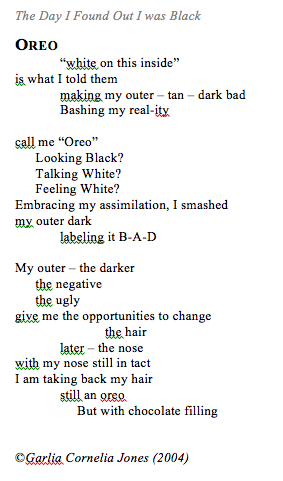
Oreo - The Day I Found Out I was Black, Garlia Cornelia Jones-Ly

A Shout-Out to all my OREOS!

Happy Friday!

In honor of the end of the work week, let’s keep it light… with a poem….

This poem is from “The Day I Found Out I was Black” – which was performed in 2004 at Indiana University.  I haven’t read it in quite some time, so looking at it now made me chuckle  a little.  While I seriously had those feelings, it’s nice to have gotten past them, but I know I’m not the only one who felt that way or who feels that way.  I have encountered many “oreos” since high school… had I known more, we could have bonded… but not all “oreos” make friends…you smile at one another, wave, have polite conversation, but that’s pretty much it.

Last week, there was a re-tweet by playwright Katori Hall of a link to young woman’s play “Life as an Oreo” by April A. Jones (@aprilreign91) – I have been thinking of this since then and dedicate this post to April and all the other Oreos out there!


oreo1


oreo poem


A Shout-Out to all my OREOS!

Happy Friday!

In honor of the end of the work week, let’s keep it light… with a poem….

This poem is from “The Day I Found Out I was Black” – which was performed in 2004 at Indiana University.  I haven’t read it in quite some time, so looking at it now made me chuckle  a little.  While I seriously had those feelings, it’s nice to have gotten past them, but I know I’m not the only one who felt that way or who feels that way.  I have encountered many “oreos” since high school… had I known more, we could have bonded… but not all “oreos” make friends…you smile at one another, wave, have polite conversation, but that’s pretty much it.

Last week, there was a re-tweet by playwright Katori Hall of a link to young woman’s play “Life as an Oreo” by April A. Jones (@aprilreign91) – I have been thinking of this since then and dedicate this post to April and all the other Oreos out there!


oreo1


oreo poem


Helmet Hair

Gabby Douglas made me think a lot this summer… I wrote this right before the Olympics wrapped… I suppose I finally have the guts to post it …5 months later… remember my procrastination problem…

______________

Before my 1st communion in 2nd grade, I begged my mom for a perm. The other black girls in my elementary school had perms, and I wanted silky straight hair like theirs instead of my thick, almost unmanageable mane. Until then, my hair had been completely natural. For the first 5 years of my life, our nanny, Mary, would wash, blow dry and use a curling iron to straighten my hair with Vitapointe. Looking back, I wish that had been the case forever – I would have had the long hair I wanted… but natural. There is a photo of me with my brother on a “Slip and Slide” before my perm – my afro was large and in charge! How embarrassed I was to let the white girls at school see me like that. How proud I would be now.

...my afro was large and in charge...

…my afro was large and in charge…

As a child, I loved being light-skinned. I was comforted by the fact that I was closer to white. My hair, on the other hand, wasn’t quite there yet. My mother’s curly and easily manipulated hair straightened with ease, while mine broke, burned and everything else if not properly cared for.

As a child, I loved being light skinned…

So when I saw Gabby Douglas at the gymnastic trials in June, I got it. I didn’t need any explanation for her hair, nor did I think it was any of my business. I was thrilled to see she and Elizabeth Price (the other Black teen who qualified as an alternate) on the team! The last time I watched so much gymnastics, Shannon Miller and Dominique Dawes reigned supreme. It was wonderful to watch this milestone take place in the history books for so many young black girls and women (including my 5 month old daughter)! It was nice to be excited again about a sport I admired so much as a pre-teen.

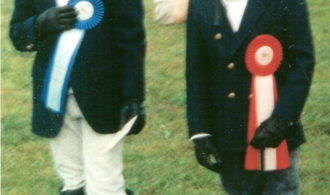
I had my own Olympic hopes once, but as an equestrienne in dressage and show jumping. Not nearly as “hair-raising” as gymnastics, but nonetheless, a fine and decidedly “elite” sport. Even more misunderstood and still requiring training that can often be expensive. Unfortunately, my brother and I stopped riding before that dream could come true (or else my parents, like Gabby’s might have been faced with similar financial difficulties). I stuck with and excelled at more artistic things: ballet, singing, and the flute.

“I had my own olympic hopes once, but as an equestrienne…”

Remember the “kiddie perm” from 2nd grade? Well, I went swimming that summer – and my hair was badly damaged. My “large and in charge afro” – destroyed. By the time I went to band camp, the only option while away from home for so long was braids, so that my hair would stay in place and I could focus on my music. Feeling unsettled, I sported the braids and beads look that summer, around the same time as Serena and Venus Williams. But I wasn’t a tennis champion showcasing my fashion sense. I saw myself in the wrong body and I hated that style, as it did not fit my personality. I hated seeing my scalp and was so happy when a few braids in the back became unraveled and the girls in my cabin could see my “real hair”. I remember feeling so embarrassed, wanting nothing more than to have long flowing hair, preferably in the shape of a ponytail that swayed side to side like Abby, the blonde basketball playing twin a few years older than me in elementary and middle school  that I thought was “so cool”.

The few sprinklings of black children and teens I encountered in my “elite” activities were not interested in bonding. We glanced at each other, gave a little smile, but mainly preferred to remain the only speckle in our group of friends – shedding light on being black and embracing our race when necessary.

By the time I went to my all-girls Catholic high school, I was absolutely certain I was in the wrong body, and to emphasize how alien I felt, nicknamed myself “Oreo”, encouraging my white friends in my high school drama group to call me that (but somehow never letting my mother know).

The handful of times I sat at the black lunch table were both awkward and comfortable. I felt like I could fit in, but was afraid to fully embrace what sitting at the “Black table” meant… that I was Black.

But the one thing all of the black girls, oreos and non-oreos alike, had in common, that I was still not getting, was their hair. It always looked “tight”. Mine was usually worn in a bun, pulled back… rarely down. But when it was – I got a lot of comments… seems that my thick hair really straightened well (after I learned to take care of it). I, like Gabby, loved it long and flowing.

All of this changed, however when I went to college and encountered Blacks in a collegiate setting that made me fully embrace who I was in my natural state. I “transitioned” back to my natural hair in 2003. I owe my transition in part to Carolyn, a woman one year above me who transitioned and had the most beautiful spirals. I had no idea that’s what natural hair could look like. After letting my relaxer grow out a little bit, I realized that I too had the same spiral texture. I was scared to completely embrace something I had been trying to fry for the past 13 years or so, but I knew that who I was would only fully come through once I was less concerned with fitting into a mold that included straight hair and a keen nose.

Gabby Douglas is an Olympic champion who has so energetically broken down walls and made her country more than proud. But she is still a teenager, in predominantly white environments, trying to fit-in, trying to focus, not wanting to be bothered and doing what most of the other girls around her are doing, which in her case, means throwing her hair into a pony-tail that doesn’t really sway, but is good enough to please her surroundings and get her through the day.

When we look to her in 2016 Brazil, she will be 20, have a few endorsements under her belt and most likely a “make-over” of some sort. Her story will have inspired millions and her hair… well, we’ll just have to see…